Infrastructure That Thinks
Relay classifies, routes, retries, and explains your background jobs automatically — describe what you need in plain English, or queue it the usual way.
import { Relay } from "@relay/sdk";const relay = new Relay({ apiKey: process.env.RELAY_API_KEY! });// Describe the job - Relay classifies it and routes it to a queue.const job = await relay.run("Send welcome email to user@email.com");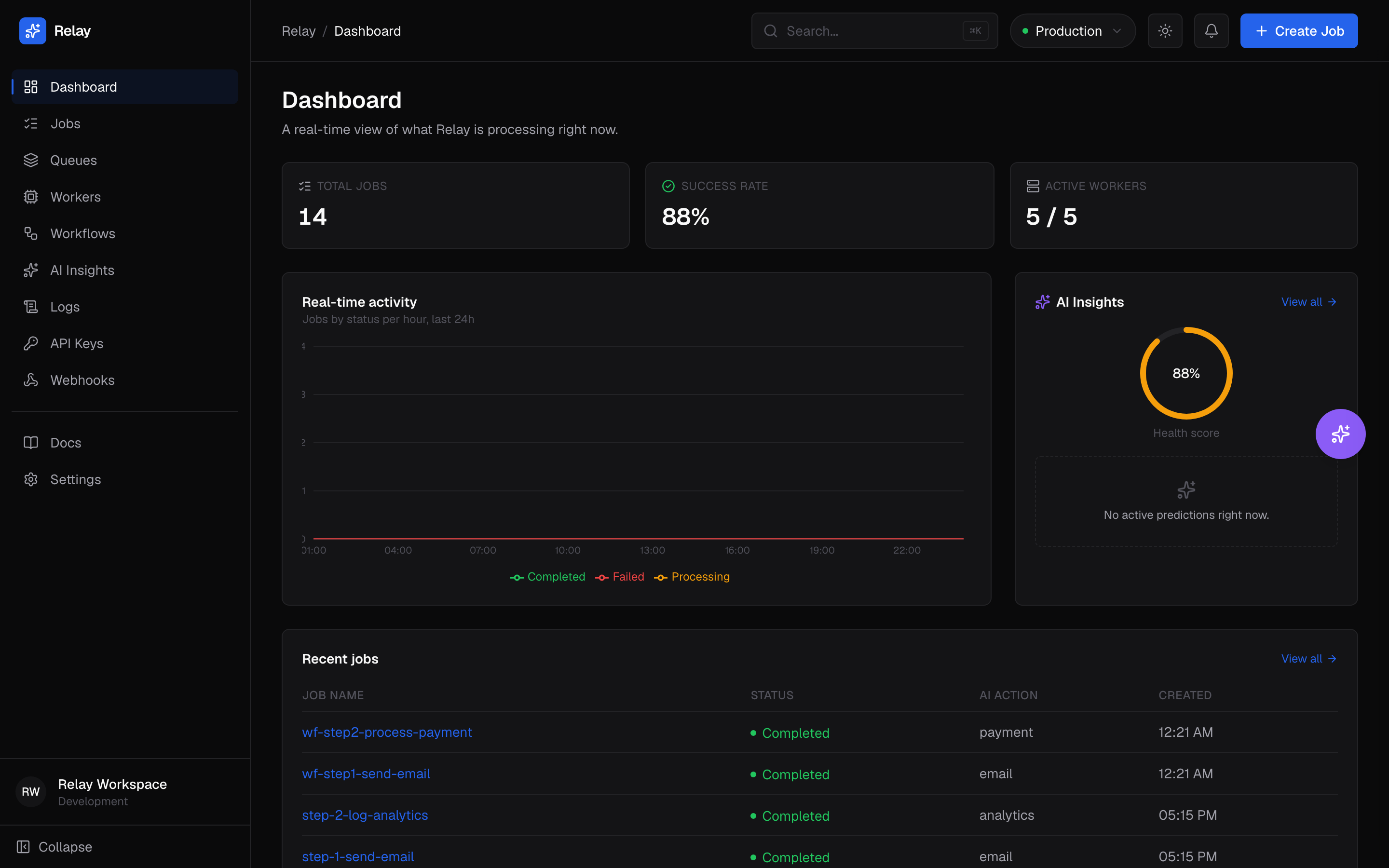
Everything is decided for you
Relay handles the operational decisions most job queues leave to you.
AI job classification
Describe a job in plain English and Relay classifies it and routes it to the right queue — no manual wiring.
Retries with backoff
Failed jobs retry automatically with exponential backoff, so transient failures don't need a human.
Failure analysis
Recurring errors are grouped into patterns, with a suggested fix and a confidence score. You decide what to apply.
Failure predictions
Relay estimates failure probability and expected duration per job type from your real run history.
Queue controls
Set concurrency per queue, and pause or resume a queue at any time.
Workers, logs and webhooks
Track worker heartbeats, browse job logs, receive webhooks on job events, and manage API keys from the dashboard.
How it works
Send a job via the SDK
Call relay.run() with a plain-English description, or create a job directly on a queue with relay.jobs.create().
AI classifies and routes it
Relay works out what kind of job it is and places it on the right queue automatically.
Relay runs, retries, and explains failures
Workers execute the job with retries and backoff. When something keeps failing, AI analysis points to the likely cause.
Operate your queues by chatting
Ask the AI agent about your jobs, queues, and workers. For anything destructive, it asks first — nothing runs until you click Approve or Reject.
This action needs your confirmation before I run it.
Chain jobs into workflows
Define ordered steps across your queues, run them on demand, and follow each run from the dashboard or the SDK.
step 1
send-welcome-email
step 2
provision-account
Open source
Relay's backend, dashboard, and TypeScript SDK live in one public repository. Read the code, run it locally, or open an issue.
View on GitHubSee it running
Sign in to explore the Relay dashboard with live queues, jobs, and AI insights.
Request a demo